
What the MEMA Study Actually Says
The Marine Ethanol: Unlocking the US Opportunity report, published 11 November 2026 by MEMA, finds that ethanol performs acceptably in the dual-fuel engines fitted to the world’s existing fleet of methanol-capable vessels, requiring only minor modifications rather than a full engine redesign.[2] The finding matters because it shortens the bridge between today’s fossil-methanol bunkering reality and the future where green e-methanol — synthesised from captured CO₂ and renewable hydrogen — is available at scale and competitive cost.
The study frames US ethanol as a near-term drop-in, not a permanent solution. Its carbon credentials depend heavily on feedstock and logistics: corn-derived ethanol carries a significantly different lifecycle profile from cellulosic or waste-based ethanol. Ship operators and compliance officers will need to scrutinise well-to-wake intensity values before counting any ethanol tonne toward FuelEU Maritime targets.
Why This Is a Story About E-Methanol, Not Just Ethanol
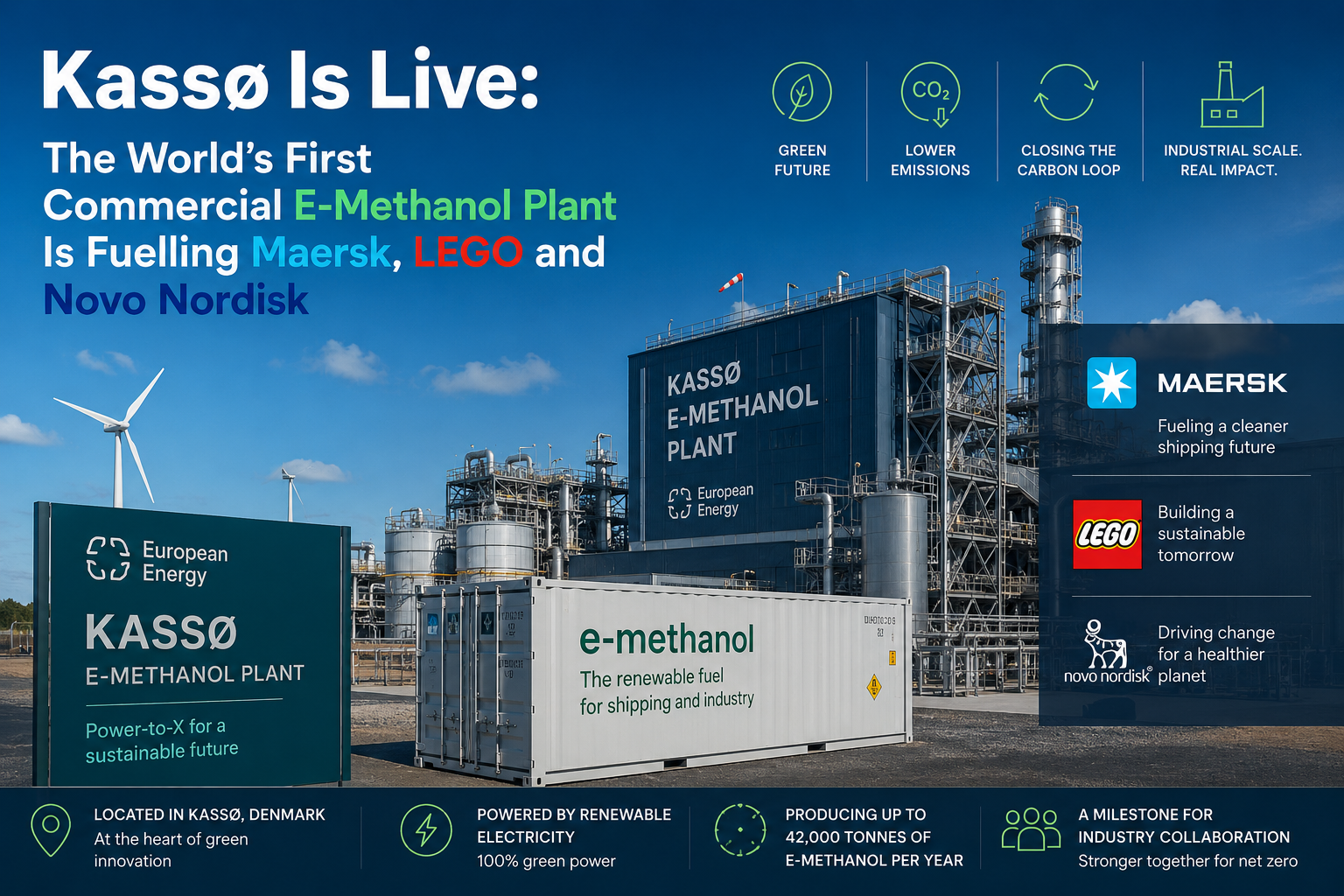
The strategic read for the e-methanol sector is straightforward: every vessel commissioned with methanol-ready propulsion is a potential future customer for green synthetic methanol. Maersk’s Laura Mærsk — the first methanol-fuelled container vessel — and the broader dual-fuel orderbook were always predicated on e-methanol becoming the long-run fuel. The MEMA report does not challenge that thesis; it reinforces it by confirming that the hardware already installed can tolerate fuel-mix flexibility, which reduces the commercial risk for shipowners committing to methanol propulsion ahead of full e-methanol supply. Projects such as the planned Kassoe e-methanol facility in Denmark are targeting precisely this demand pool. The parallel Plug Power–Arcadia eFuels 280 MW Power-to-Liquid partnership, also announced in Denmark in November 2026, signals that large-scale electrolyser capacity is being lined up to serve the synthetic fuels market — including maritime.
AI-assisted route and bunkering optimisation is already being explored by several shipping groups to minimise the cost penalty of alternative fuels: for methanol-fuelled vessels, optimising port calls around available green-methanol supply points could materially improve the economics during the transition period when supply is patchy and priced at a premium to HSFO.
Regulatory and Competitive Context
FuelEU Maritime enters force in 2025 and ratchets GHG intensity targets progressively through 2050. Ethanol, like methanol, is not explicitly mandated — both compete on lifecycle carbon intensity. Shipowners have already flagged uncertainty: an assessment published by Hellenic Shipping News warns that the maritime fuel transition could slip beyond 2030 if methanol demand remains uncertain.[1] The MEMA study is partly a supply-side answer to that demand uncertainty: if ethanol can fill dual-fuel tanks while e-methanol scales, shipowners face less stranded-asset risk on vessels ordered now.
One honest caveat: the efficiency objection that dogs e-fuels in road transport — ICCT data puts the well-to-wheel efficiency of an e-fuel combustion pathway at around 16%, versus 72% for a battery-electric vehicle — matters far less here. Deep-sea shipping cannot be battery-electrified at current energy densities, which is precisely where synthetic and bio-derived liquid fuels hold a structural advantage over electrification. The question for maritime is not ‘e-fuel versus battery’ but ‘which low-carbon liquid fuel, at what cost, from which supply chain.’
Sources
- Shipowners warn fuel transition could slip beyond 2030 as methanol demand remains uncertain
- U.S. Ethanol Could Fuel Growing Fleet of Methanol-Capable Ships, Study Finds
Featured image via Unsplash.
This is not an official site. It is published by a private company and does not emanate from any public authority, institutional programme, government department or research organisation. It represents none of them and speaks for none of them in any capacity.
Nature of the content. Articles are documentary summaries drawn from cited public sources. They may contain inaccuracies, omissions or information that has since become outdated. No financial, technical, legal or investment advice is provided.
Always verify against primary sources. For any information concerning a public programme, a regulation or an institutional project, only the publications of the competent authority are authoritative.
© 2026 BESS Energie SRL · BCE 0698.949.732 · info@bess.be




Leave a Reply