
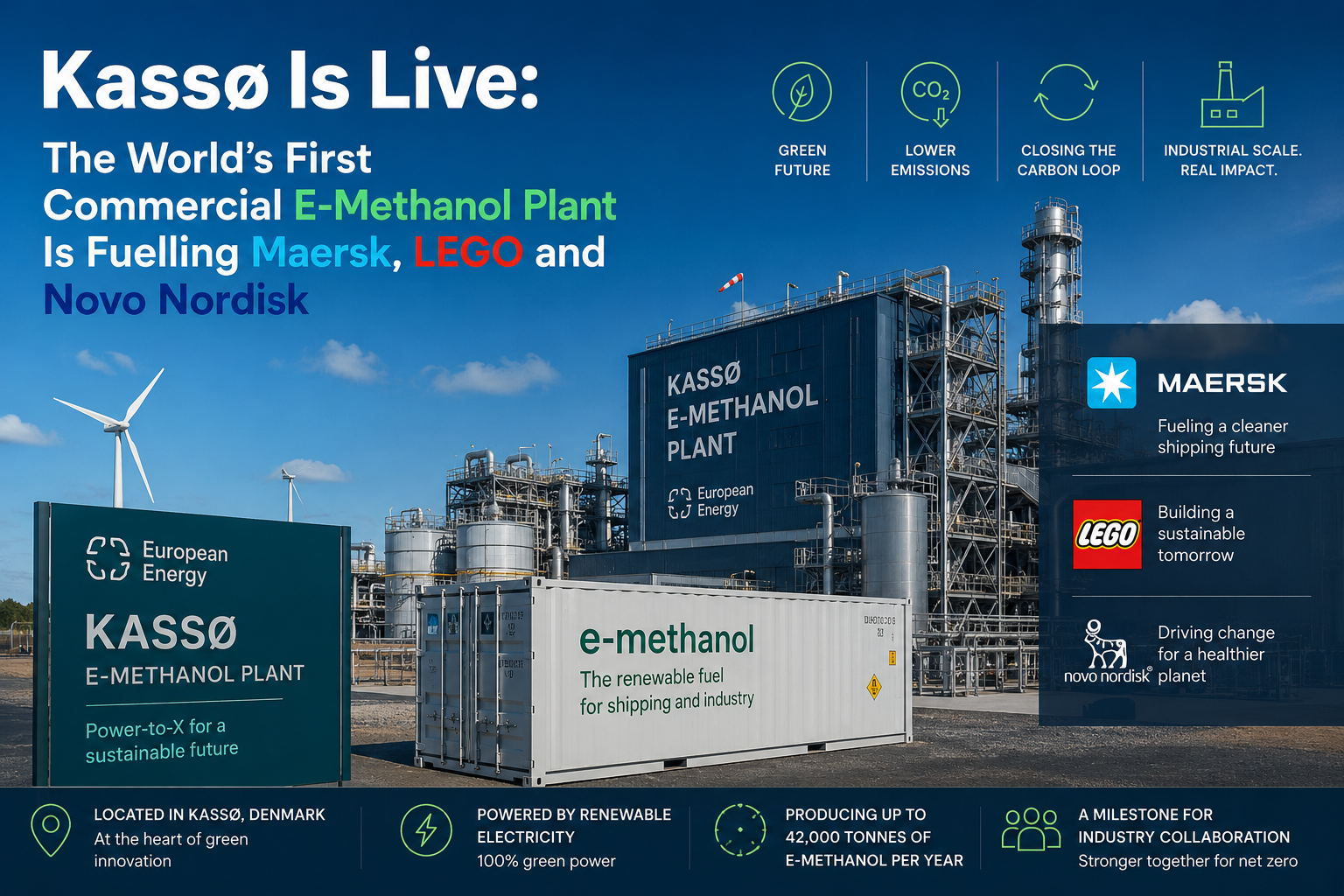

Kassø Is Live: The World’s First Commercial E-Methanol Plant
Is Fuelling Maersk, LEGO and Novo Nordisk
On May 13, 2025, European Energy officially inaugurated the Kassø e-methanol facility in southern Denmark — the world’s first commercial-scale plant dedicated to producing green synthetic methanol. In February 2026, Laura Mærsk received 1,000 tonnes of e-methanol directly from the Kassø facility for a commercial voyage. The plant is now ramping to its full capacity of 42,000 tonnes per year. Three of the world’s most recognisable companies — Maersk, LEGO and Novo Nordisk — are already offtakers. The e-methanol era has begun.
The Kassø Facility — How the World’s First Commercial E-Methanol Plant Works
The Kassø e-methanol facility is operated by European Energy, the Danish renewable energy company, in a joint venture with Mitsui & Co. of Japan. It is located adjacent to the 304 MW Kassø Solar Park in southern Denmark — Northern Europe’s largest solar installation — which provides the bulk of the renewable electricity needed for the production process.
The production process combines two feedstocks: green hydrogen produced on-site by electrolysers powered by the adjacent solar park, and biogenic CO₂ captured from a nearby biogas facility in Tønder and from waste incineration. The two feedstocks are combined in a catalytic methanol synthesis reactor to produce raw e-methanol, which is then distilled to commercial purity.

The facility began generating green hydrogen in January 2025 using the electrolysers. First raw e-methanol was produced in May 2025. European Energy and Mitsui secured green financing for the project in January 2026, with Nordea and SMBC as bookrunners, supported by a partial guarantee from EIFO. Full ramp-up to 42,000 tonnes per year is expected in Q2 2026.
- Developer — European Energy A/S (Denmark) + Mitsui & Co. (Japan) joint venture
- Location — Aabenraa, southern Denmark · adjacent to Kassø Solar Park
- Capacity — 42,000 tonnes e-methanol per year at full ramp-up
- Electricity — 304 MW Kassø Solar Park (50%) + grid renewable power
- CO₂ source — biogenic CO₂ from Tønder biogas facility + waste incineration
- CO₂ reduction — up to 97% vs fossil methanol · ISCC Plus certification
- First production — May 2025 · first commercial bunkering February 2026
- Financing — green bridge facility January 2026 · Nordea · SMBC · EIFO guarantee
Three Landmark Offtakers — Maersk, LEGO and Novo Nordisk
The Kassø facility’s commercial credibility rests on three offtake agreements with globally recognised customers — each representing a different application of e-methanol as a decarbonisation tool.
The diversity of these three customers illustrates the fundamental advantage of methanol as a platform molecule. Unlike hydrogen — which requires dedicated infrastructure — methanol is a liquid at ambient conditions, compatible with existing storage and distribution networks, and useful across maritime, industrial and chemical applications simultaneously.
When you look at the production from Kassø, it is, of course, just a literal drop in the ocean — so we need to scale up and we need to bring costs down.
Emil Vikjær-Andresen · EVP Head of Power-to-X · European Energy · 2025Laura Mærsk — The Vessel That Proved the Concept
Laura Mærsk is a 2,100 TEU dual-fuel feeder container vessel — the world’s first container ship capable of operating on methanol as a primary fuel. Launched in 2023, it has been operating commercially since then, running on a combination of bio-methanol and e-methanol. In February 2026, it received 1,000 tonnes of e-methanol directly from the Kassø facility in a commercial bunkering operation — the first time a container vessel had been bunkered with e-methanol produced at commercial scale from a dedicated facility.

Maersk’s fleet strategy is explicitly fuel-agnostic: the company operates what it calls a “diversified, fuel-agnostic portfolio” that includes e-methanol, bio-LNG and other pathways. In 2025, ten dual-fuel methanol vessels joined the fleet, with six additional dual-fuel vessels to be delivered in 2026. The framework agreement with European Energy covers up to 300,000 tonnes of e-methanol per year starting from 2025/26 — seven times the entire annual capacity of the Kassø plant — signalling the scale of supply that Maersk needs as its methanol fleet expands.
FuelEU Maritime — The Regulation That Makes E-Methanol Mandatory
The commercial case for e-methanol in shipping is reinforced by FuelEU Maritime, the EU regulation that entered into force in January 2025 and requires ships calling at EU ports to progressively reduce their greenhouse gas intensity from 2025 through to 2050. E-methanol, with its 97% lifecycle CO₂ reduction vs fossil methanol, qualifies as a compliant fuel under FuelEU’s well-to-wake accounting methodology.
The regulation creates a structural demand signal that extends far beyond individual corporate sustainability commitments. Every shipping company operating EU routes faces compliance obligations — and e-methanol, along with bio-LNG, is currently one of the most commercially available compliant pathways at scale.
What Natural Hydrogen Means for E-Methanol Economics
The Kassø facility demonstrates that e-methanol works technically and commercially. The challenge, as European Energy’s own EVP acknowledged, is scale and cost. At current production costs of approximately €920 per tonne, e-methanol is significantly more expensive than fossil methanol (approximately €280–320 per tonne). The primary cost driver is green hydrogen — at €6.20/kg, hydrogen alone accounts for a large fraction of methanol production cost.
Natural geological hydrogen from Lorraine — if confirmed commercially viable at the REGALOR II borehole site at €0.50/kg target cost — would transform e-methanol economics entirely. At that price, methanol production costs could fall to approximately €250–300 per tonne — competitive with fossil methanol without any carbon pricing. The Greater Region, with its planned HY4Link hydrogen pipeline connecting Lorraine to Belgium and Germany, CO₂ from industrial point sources, and proximity to European ports via the Rhine-Meuse waterway system, is geographically well-positioned for large-scale e-methanol production at competitive cost.
Kassø proved the concept. Lorraine natural hydrogen, if confirmed in 2027, could prove the economics.
- → European Energy — “Kassø e-methanol facility officially inaugurated” — May 13, 2025
- → European Energy — “European Energy and Mitsui secure green-financing bridge facility” — January 20, 2026
- → Ship & Bunker — “European Energy Supplies E-Methanol to Maersk Dual-Fuel Feeder Vessel” — February 20, 2026
- → Ship & Bunker — “Maersk’s E-Methanol Supplier European Energy Kicks Off Production” — 2025
- → State of Green — “World-first: Maersk vessels to bunker green methanol in Denmark” — October 2025
- → Maersk — “Decarbonising Ocean Shipping” — sustainability report 2025
- → European Energy — “Methanol sales” — Kassø offtakers · LEGO Group · Novo Nordisk
- → FDE / REGALOR II — Lorraine natural hydrogen · Pontpierre 3,655m

Leave a Reply