

What the Infringement Action Actually Means
ReFuelEU Aviation requires Member States not only to transpose the regulation but to establish and communicate enforceable national penalty structures for non-compliant fuel suppliers and aircraft operators. When the Commission filed proceedings against 13 governments in June 2026 for failing to do so, it demonstrated that the synthetic-fuels regulatory architecture is not aspirational — it carries legal teeth. For the e-methanol industry, the lesson is direct: FuelEU Maritime, which mandates progressive reductions in the greenhouse-gas intensity of energy used by large ships calling at EU ports, will likely be enforced with equal rigour. Shipowners and fuel buyers who treat compliance timelines as soft targets are taking on sovereign legal risk.
The political significance is also considerable. The Commission’s action signals that member-state discretion over implementation speed is narrowing. Ports, bunker suppliers, and methanol producers serving EU trade routes — including the infrastructure being developed around North Sea and Baltic hubs — now have greater regulatory certainty that demand mandates will bite, which in turn strengthens the investment case for dedicated e-methanol production and bunkering capacity.
E-Methanol and the Maritime Opportunity
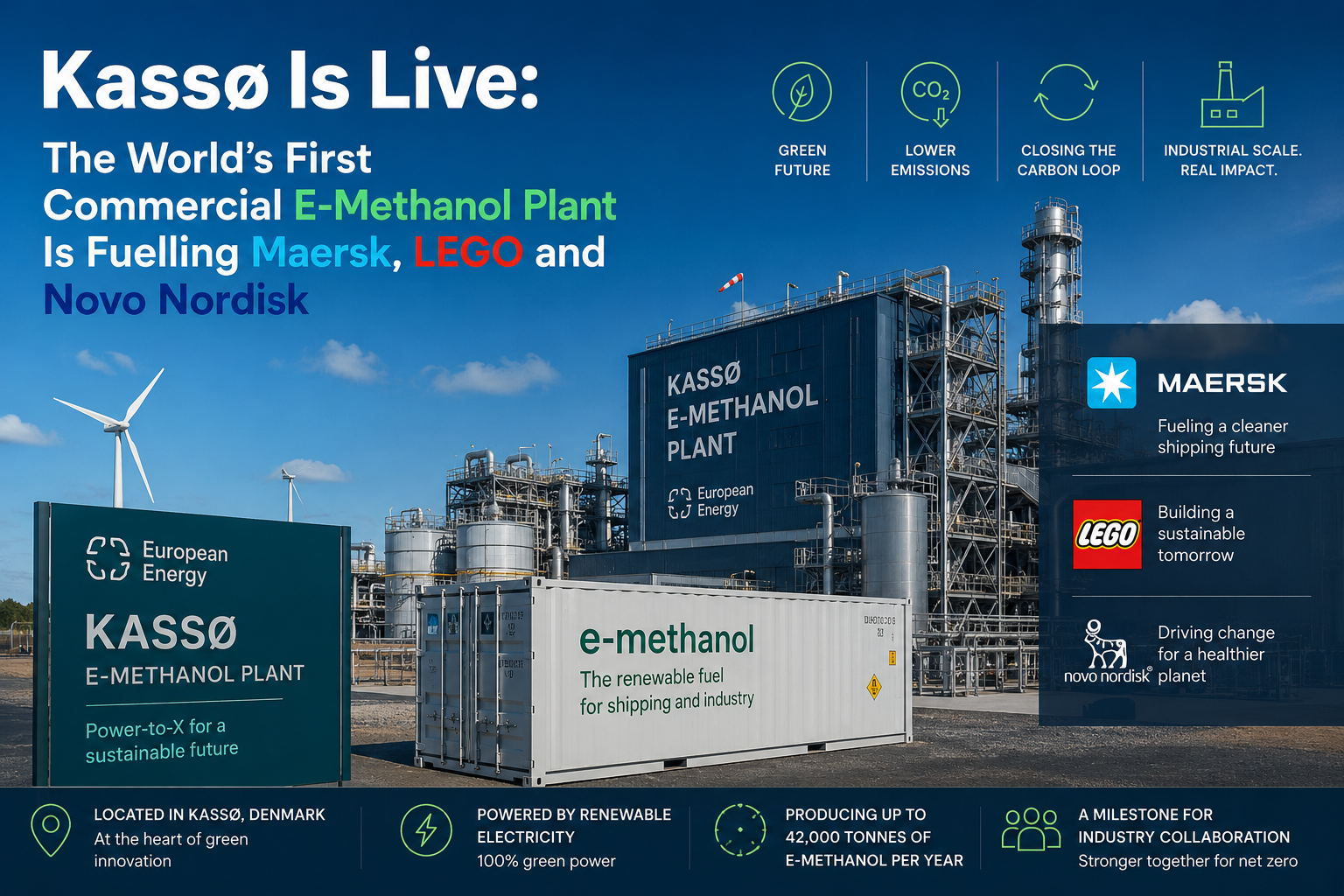
DNV’s mid-2026 database records 425 vessels with methanol-compatible engines on order globally, a figure that reflects industry confidence in methanol as a long-term marine fuel rather than a transitional hedge. E-methanol — produced by combining green hydrogen with captured CO₂ — fits neatly into FuelEU Maritime’s well-to-wake accounting framework, offering substantial GHG-intensity reductions relative to conventional heavy fuel oil when the hydrogen is made from renewable electricity and the CO₂ is sourced from biogenic or atmospheric streams. Major carriers have already committed to methanol-fuelled newbuilds, and bunkering infrastructure is scaling alongside vessel orders at key European ports. Shipping operators are increasingly deploying AI-assisted route and bunkering optimisation tools to schedule methanol stem quantities precisely, reducing the working-capital burden of carrying large fuel inventories while ensuring compliance with port-state reporting obligations.
The chemistry is straightforward but the economics remain demanding. E-methanol currently costs a significant premium over fossil methanol, and the margin narrows only as electrolyser costs fall and carbon pricing rises. The infringement proceedings serve as a forcing function: if penalty regimes are credibly enforced, the cost of non-compliance rises, improving the relative economics of compliant fuels like e-methanol even before any further technology cost reduction.
Regulatory Coherence Is the Sector’s Biggest Enabler
The broader synthetic-fuels sector faces a recurring criticism: mandates are passed but enforcement is uneven, creating uncertainty that delays final investment decisions. The June 2026 infringement action directly addresses that concern for aviation and, by precedent, for maritime. Producers developing e-methanol capacity — whether integrated with electrolysis projects or reliant on CO₂ captured from industrial point sources — need 15-to-20-year revenue visibility to justify capital outlay. Firm enforcement of blending and GHG-intensity mandates, backed by Commission legal action where necessary, is arguably more valuable to project financiers than any direct subsidy.
For the e-methanol supply chain, the message from Brussels is clear: build the capacity, because the demand obligation will be enforced. That alignment between regulatory intent and legal action is precisely what the sector has been waiting for.
Sources
Featured image via Unsplash.



Leave a Reply