
What the D20 Reveals About Methanol’s Cross-Sector Momentum
Horse Powertrain’s D20 is engineered to run on neat methanol — no blending, no compromise — and its 47% fuel-to-energy ratio is competitive with modern diesel engines. That figure matters because it validates methanol combustion at scale without requiring a clean-sheet engine architecture. For fuel producers and infrastructure investors, the D20’s debut is evidence that methanol demand will not remain confined to shipping: a growing fleet of methanol range-extender electric vehicles on Chinese and European roads would create a second, sizeable off-take channel alongside maritime bunkering.
It is worth stating the standard efficiency caveat plainly: for light road vehicles, a battery-electric drivetrain converts roughly 70–80% of renewable electricity to motion, whereas an e-fuel powertrain delivers perhaps 13–20% well-to-wheel — around five times more electricity for the same kilometre. E-fuels in passenger cars are therefore an expensive choice unless that electricity is unavailable or unless the vehicle is among the 1.4 billion combustion units already in service. The more compelling case for methanol as a fuel is exactly where the D20’s range-extender architecture points: bridging duty cycles that batteries alone cannot serve, and supplying the maritime sector, where no battery chemistry comes close to the energy density needed for deep-sea voyages.
Maritime Methanol: From Maersk to FuelEU Maritime
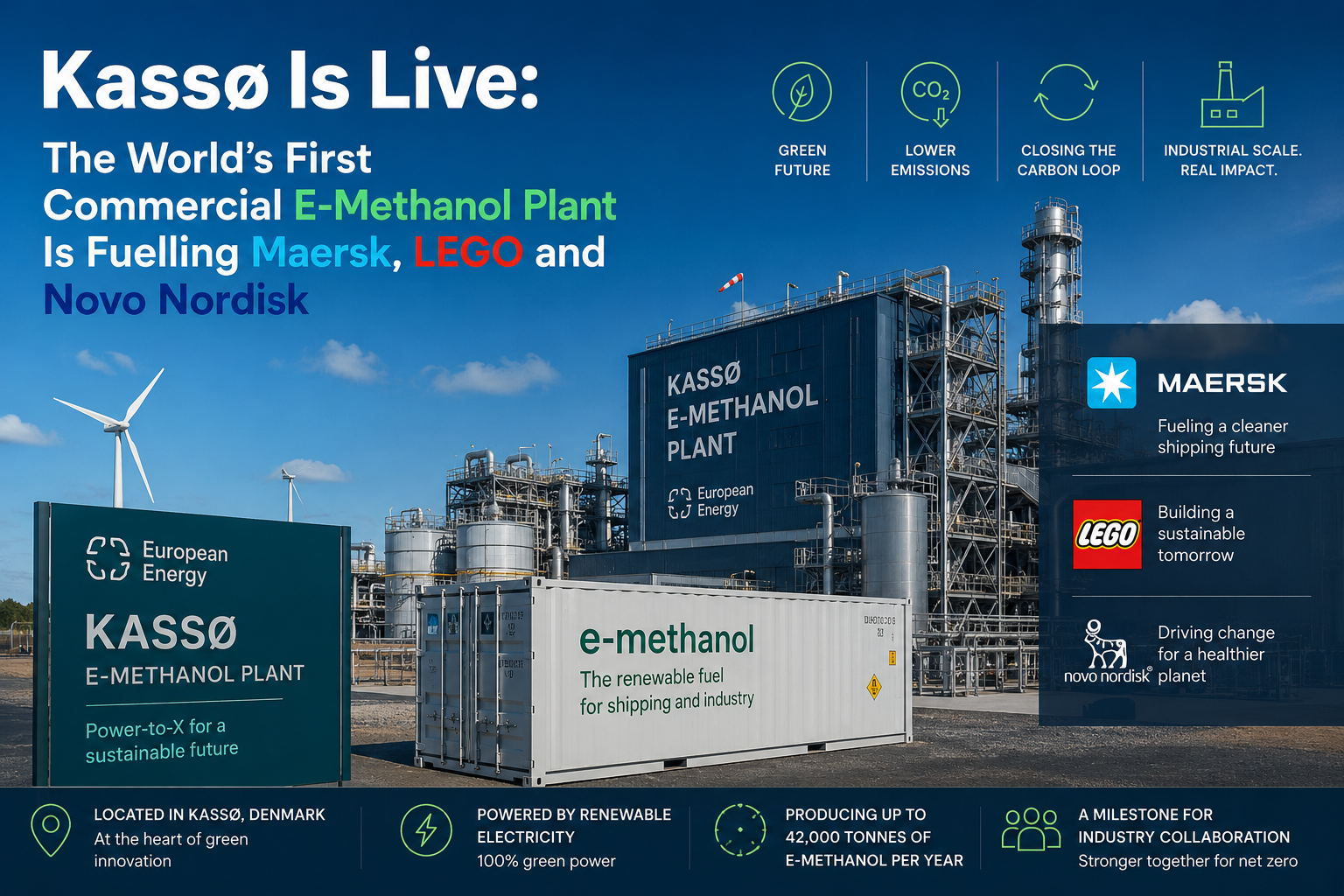
Shipping is already the leading proving ground for green methanol at commercial scale. Maersk has taken delivery of multiple methanol-capable containerships and has committed to sourcing green methanol from facilities including the Kassoe e-methanol plant in Denmark, which uses renewable electricity and biogenic CO₂ to synthesise fuel — the same power-to-liquid chemistry that could eventually supply automotive methanol markets. FuelEU Maritime, which sets greenhouse-gas intensity limits for ships calling at EU ports, is the regulatory forcing function: shipping companies that cannot meet the trajectory face escalating penalties, making green methanol procurement a compliance imperative rather than a voluntary act. AI-assisted fleet route and bunkering optimisation tools are already being piloted by several operators to minimise methanol consumption across voyage profiles and align refuelling calls with port availability.
E-methanol chemistry is straightforward in principle — CO₂ plus green hydrogen over a copper-zinc catalyst — but the economics remain tight. Green hydrogen cost is the dominant variable; electrolysis efficiency improvements and falling electrolyser capital costs are gradually narrowing the gap with fossil methanol. Every new end-use market that the D20 and similar engines open up improves the business case for dedicated e-methanol production facilities by spreading fixed infrastructure costs across a larger volume.
Investment Signal for E-Methanol Producers
The convergence of automotive range-extender development and maritime bunkering demand is precisely the market structure that e-methanol producers need to justify gigawatt-scale electrolyser investments. A fuel that is simultaneously compliant with FuelEU Maritime, compatible with Horse Powertrain’s D20 architecture, and chemically identical whether produced in Denmark or the Middle East presents a rare standardisation advantage. Port terminal operators, shipping lines, and now vehicle powertrain developers are all reading from the same molecular formula: CH₃OH.
For project developers and investors tracking the synthetic-fuels landscape, the D20’s Beijing debut is a data point worth filing alongside offtake agreements and electrolyser orders. It confirms that the combustion engineering community — responsible for the physical engines that must ultimately burn e-methanol — is committing R&D budgets to methanol compatibility rather than treating it as a transitional curiosity.
Sources
- Horse Powertrain presents methanol range extender — electrive.com
- HORSE D20 Methanol Range Extender Debuts With 105 kW Output
- news: Horse Powertrain reveals methanol REEV engine — DieselNet
- Horse Powertrain demonstrates broadest powertrain solutions line-up at Beijing Auto Show 2026
Featured image via Unsplash.




Leave a Reply